
Prerequisites
Read these first if watermarking, TrustZone display, or content credentials are new.
- Digital watermarking overview — visible vs invisible marks (primer, not product)
- Arm TrustZone for Cortex-A — secure world / TEE threat model on mobile SoCs
- C2PA specification — signed content credentials in metadata
- OP-TEE documentation — open Trusted Execution Environment used in mobile TEE research
Photos are harder than messages
Every messaging app encrypts text in transit. Photos look equally protected — until you follow the pixels. Compression, thumbnails, CDN caches, and a display stack that may decode on a GPU you do not control each create a place where someone can see or alter content without breaking “the file was encrypted on the wire.”
That chain is what I studied in dissertation work on mobile image confidentiality and integrity, in Crestone (archived end-to-end integrity research), and in Rushmore (TrustZone secure display). Generic crypto tutorials treat the image as an opaque blob. Mobile photo security must follow where pixels become visible, not only whether ciphertext crossed the network.
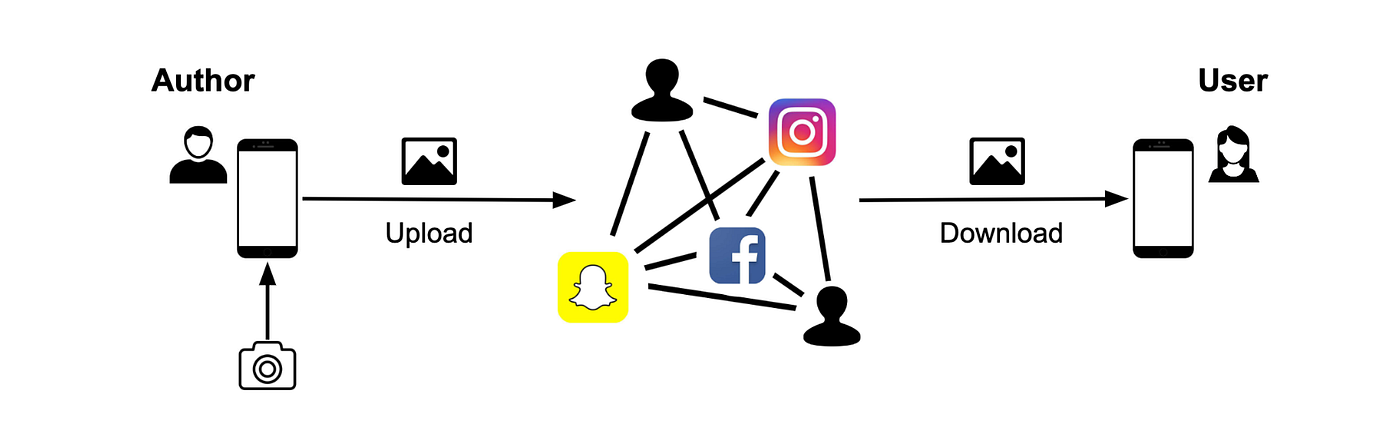
Figure 1. A typical mobile photo path: capture → upload through third-party services → download on a consumer device.
One path, hop by hop. At each hop I name the property that dies, then the solution family that addresses that failure — not a CIA × crypto encyclopedia.
Hop 1 — Capture and local decode
On the producer device the camera pipeline and gallery already hold plaintext bitmaps. A compromised OS or a malicious app with storage access reads pixels before any upload encryption runs. Confidentiality dies locally even if TLS will later protect the wire.
Solution family: encrypt before anything untrusted can read. Symmetric encryption of pixel bytes (or the container) keeps content opaque to other apps and to backups that should not see it. Upside: mature, fast, no visual quality loss. Downside: every legitimate viewer needs the key, and any “open in Photos to crop” path forces a decrypt that re-exposes pixels. Transit TLS does not help here — the leak already happened on device.
Hop 2 — Upload, resize, and middle services
Upload paths almost always re-encode: server-side resize, thumbnail generation, CDN edge copies. Those hops need visible pixels (or at least decoded frames) to do their job. Confidentiality to intermediaries dies the moment a relay or processing tier must produce a thumb. Metadata signatures often die in the same step — EXIF and sidecar credentials get stripped on re-encode.
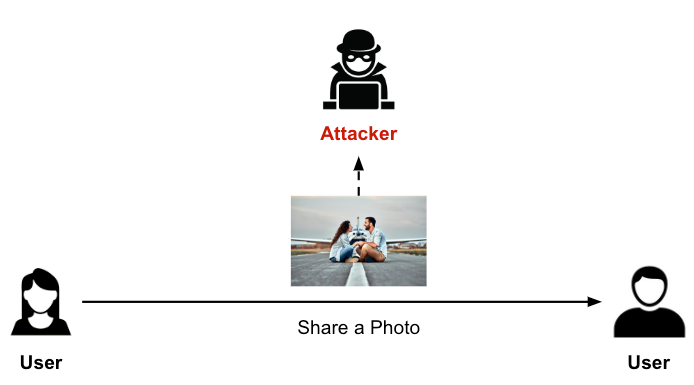
Figure 2. Middle-path failure: an intermediary or processing hop sees content you thought stayed private.
Solution family: accept visibility, bind claims into the content. When a service must see pixels, encryption alone is the wrong borrow. Watermarking embeds authenticity or integrity marks inside the image — spatial (e.g. LSB) or transform-domain (DCT/DWT) so JPEG-tolerant schemes survive compression better. Upside: works when platforms strip headers. Downside: quality cost, attack surface against weak marks, and key management for detection. For mail- or chat-shaped products, for example, attachment pipelines that generate previews are exactly this hop: if send waits on a CDN publish of a preview, you have already decided some middle tier sees the image.
Hop 3 — Re-share and tampering in the graph
After download, Bob edits a news photo and re-uploads. Without tamper detection, integrity dies in the sharing graph. Screenshots and collage edits make file-level signatures irrelevant — the bytes that left the camera are gone.
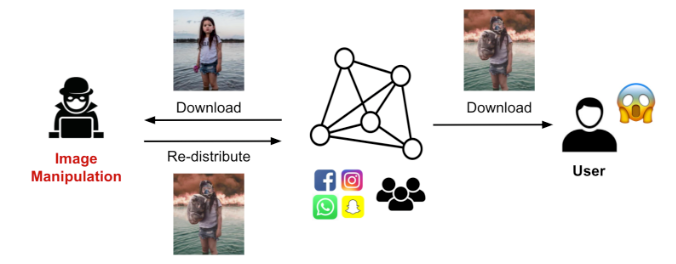
Figure 3. Integrity failure after capture: tampered content re-enters distribution.
Solution family: provenance that survives the graph, plus forensics when it does not. Digital signatures over perceptual or content hashes prove origin while the image stays visible — authenticity and integrity without hiding pixels. C2PA-style content credentials package that idea as signed manifests. They are strong when metadata survives; after most social re-uploads they are gone. Then digital image forensics (pixel inconsistencies, shadow physics, GAN artifacts) is the post-hoc integrity check with no enrollment at capture time. It cannot alone prove who held the camera, and detectors race adversarial editors — but it is what remains when every envelope was stripped.
Hop 4 — Decode to the panel
On the consumer device the gallery or app decodes a bitmap and hands it to a display compositor. Signing the file fails if the UI never surfaces the signature and a compromised rich OS can still show a different framebuffer. Authenticity of what the user sees dies at decode — the property that matters is whether the pixels on the panel match the claim, not whether an APK-verified blob sat on disk.
Solution family: bind proof to the display path. Research systems (including Rushmore on Arm TrustZone, and related OP-TEE / secure-world display work) move verification into a TEE-backed channel so a normal-world compositor cannot silently substitute frames. That is not product folklore about any one mail app; it is the mobile-systems answer when hop 4 is the threat. Public-key signatures still matter for enrollment and key identity — they just are not sufficient once decoded bitmaps leave the signed container.
What the path forces you to choose
| Hop | Property that dies | Wrong borrow | Better family |
|---|---|---|---|
| Local capture / gallery | Confidentiality on device | “TLS will cover it” | Encrypt before untrusted readers |
| Resize / thumb / CDN | Confidentiality to middles; metadata | Ciphertext-only thinking | Watermarks / in-content marks |
| Re-share / edit | Integrity (and often authenticity) | File hash after screenshot | Credentials when preserved; forensics after strip |
| GPU / compositor decode | Authenticity of what is shown | Sign the file only | TEE / secure display binding |
No single mechanism covers the whole path. Encryption protects bytes until something must look; watermarks and credentials protect claims when looking is required; forensics is leftover signal; secure display protects the last hop where pixels become human-visible. Design for the hop you cannot tolerate failing — because that is usually where the guarantee already ended.
References
- Rushmore — secure display on ARM TrustZone (MobiSys ’21)
- C2PA Content Credentials explained — signed manifests; strong when preserved, gone after most re-uploads
- Visible, invisible, and forensic watermarking — embedding, keys, detection workflow
- Digital image authenticity and integrity (Amped Authenticate overview) — blind analysis when no signed envelope exists
- Methods for image authentication: a survey — classic survey on authentication techniques