
Prerequisites
Read these first if zombie (defunct) processes, orphans, or fork/wait are new.
- Zombie process — exited, still in the table until the parent waits;
kill -9does nothing - Orphan process — child still running after the parent is gone (reparented to init)
- wait(2) — how a parent reads exit status and reaps the child
- fork(2) — creating a child; why parent vs child (and PPID) matter
The ps line that will not die
You run ps aux | grep my-server and see <defunct> or a state column of Z. kill -9 does nothing. Or the opposite: a worker keeps running after its supervisor crashed, PPID now 1. Both look like “something is wrong with processes,” but the fix paths diverge completely — one is a parent that never reaped, the other is a child that outlived its parent.
I taught OS labs long enough to see students reach for kill -9 on zombies every time. It never works. The process is already dead; the kernel is waiting on the parent.
Zombie (defunct) — exited, not reaped
A zombie (defunct) process has finished execution but still occupies a row in the process table. The kernel keeps a minimal struct task_struct so the parent can read the exit status via wait(), waitpid(), or wait4().
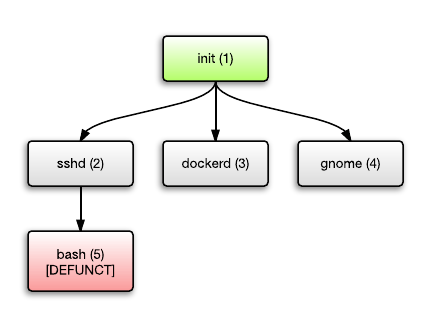
Figure 1. Zombie — child exited; parent has not reaped.
Symptoms:
ps -eo pid,ppid,stat,cmd | awk '$3 ~ /Z/'
# STAT column shows Z or Z+
You cannot kill a zombie directly — there is no user code left to signal. Fix the parent:
- Restart or patch the parent so it calls
wait()on SIGCHLD - Kill the parent (zombie becomes orphaned; see below)
- If the parent is PID 1 and stuck, you may need a reboot — init normally reaps quickly, so persistent zombies under init signal a broken init or driver bug
Zombies use almost no memory (just the process-table slot) but consume a PID. Enough of them exhaust the PID space and new processes fail to start — a real production failure on long-lived servers with buggy supervisors.
Minimal bug pattern:
// parent spawns child, never waits — zombie on every exit
pid_t c = fork();
if (c == 0) { _exit(0); }
// missing: wait(&status);
Fix in long-running servers — reap on SIGCHLD:
void on_sigchld(int sig) {
    (void)sig;
    while (waitpid(-1, NULL, WNOHANG) > 0) { }
}
// signal(SIGCHLD, on_sigchld);  // plus SA_RESTART / sigaction as appropriate
The WNOHANG loop drains every exited child in one signal delivery — important when several workers finish close together.
Orphan — parent gone, child still running
An orphan is a process whose parent terminated first while the child keeps running. The kernel re-parents it to PID 1 (init or systemd), which eventually reaps it when the child exits.
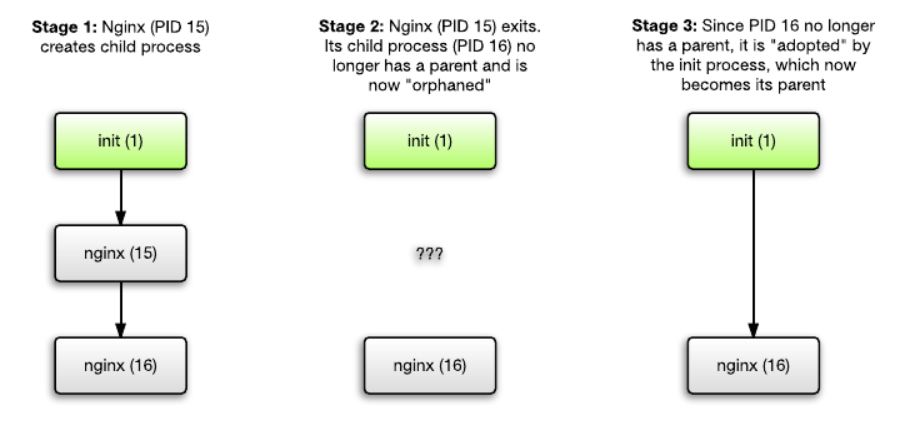
Figure 2. Orphan — parent died; init adopts the child.
Unlike zombies, orphans are live processes — memory, file descriptors, CPU time. You can kill -9 them normally:
kill -9 <orphan-pid>
Too many long-lived orphans can stress init’s reap loop, but the usual concern is resource leak (open sockets, temp files), not PID table slots. A runaway orphan holding a listening port is a kill problem; a defunct row in ps is a wait() problem.
Side-by-side
| Zombie (defunct) | Orphan | |
|---|---|---|
| Process state | Already exited | Still running |
| Who to fix | Parent must wait() |
Kill child or fix supervisor lifecycle |
kill -9 on child |
No effect | Works |
| Memory / CPU | Minimal (table entry) | Full process cost |
| Typical PPID | Original parent (not reaping) | 1 after re-parenting |
Debugging checklist
ps -eo pid,ppid,stat,cmd—Zin STAT → zombie; PPID1on a long worker → likely orphan- Find parent of zombies:
ps -o ppid= -p <zombie-pid>then inspect/kill parent - Server code: install a SIGCHLD handler or reap in a loop after every spawn
- Containers: PID 1 in the namespace must reap — minimal images that run app as PID 1 without an init wrapper (
tini,dumb-init) are a common zombie source - Double-fork daemons: the classic backgrounding pattern can orphan intentionally; know who owns reap before copying boilerplate
When a zombie’s parent is already gone, init usually reaps it within milliseconds — so a screen full of <defunct> almost always means a living parent is ignoring SIGCHLD, not an init problem.