
Prerequisites
Read these first if strings as sequences, dynamic programming, or edit distance are new.
- Edit distance — family of metrics for how many edits turn one string into another
- Dynamic programming — overlapping subproblems and a table (or cache) instead of recomputing
- How to Write a Spelling Corrector (Norvig) — fuzzy match as an engineering product, not only an interview problem
When exact match is too strict
Search fields, contact pickers, and command palettes break on one typo: "Gamboll" does not match "Gambol", even though a human sees the intent. Levenshtein distance (LD) scores that gap: the minimum number of single-character insertions, deletions, and substitutions needed to turn string A into string B. Lower distance means more similar strings.
That metric powers fuzzy contact lookup, spell-check suggestions, diff-ish UX copy (“Did you mean…?”), and lightweight dedup before hitting a server index. The naive table fill is O(m × n) time and space — fine for short UI strings, not for megabyte logs without trimming.
The dynamic-programming table
Build a matrix with (m+1) × (n+1) cells for strings of length m and n. Row 0 and column 0 hold the base cost of inserting every prefix character from empty:
        ""  G  A  M  B  O
    ""   0  1  2  3  4  5
    G    1
    A    2
    M    3
    B    4
    O    5
    L    6
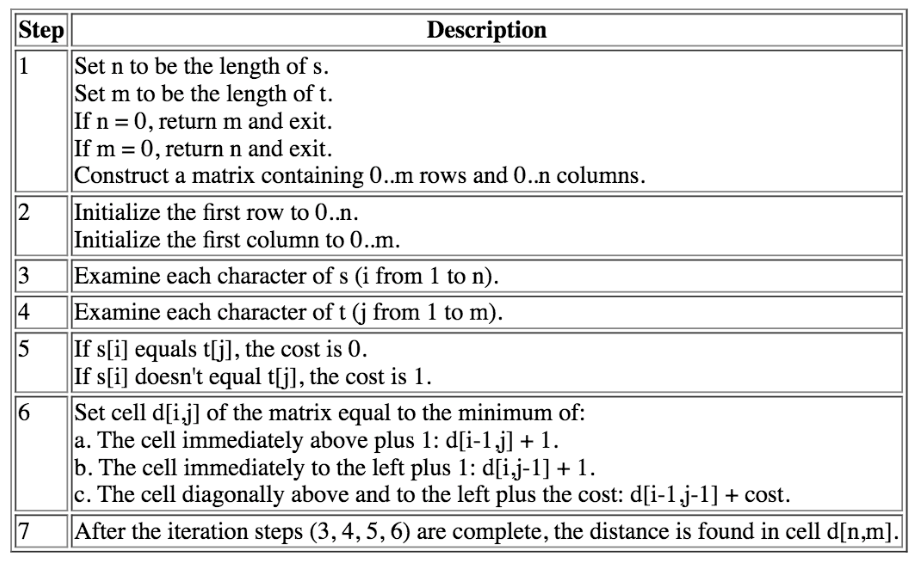
Figure 1. Initialize first row/column with 0…n and 0…m; fill each cell from neighbors.
For cell (i, j) comparing s[i-1] to t[j-1]:
- If characters match, take the diagonal:
cost[i-1][j-1]. - Else take 1 + minimum of:
- Left — insertion into
s - Above — deletion from
s - Diagonal — substitution
- Left — insertion into
The answer is cost[m][n] — bottom-right corner.
Worked example: GUMBO → GAMBOL
Compare "GUMBO" and "GAMBOL":
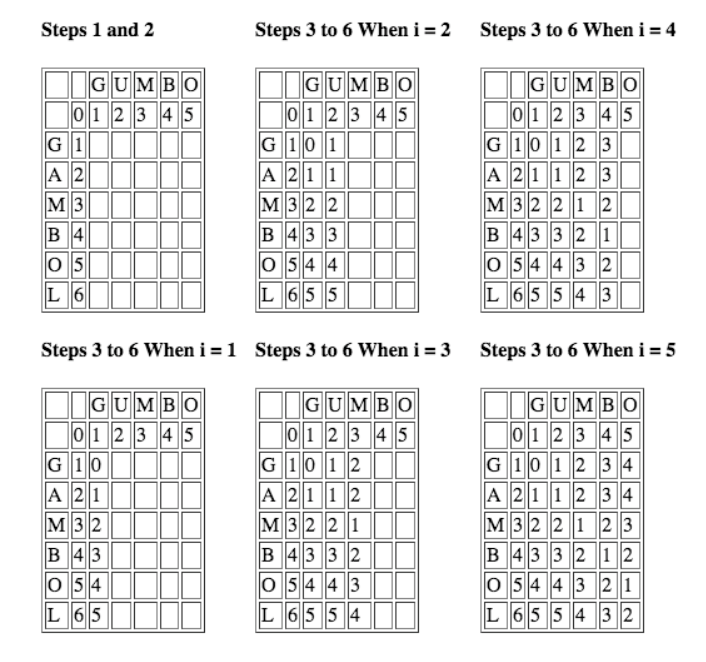
Figure 2. Final distance is 2 (lower-right cell): substitute U→A, insert L.
Tracing one path: align G, A, M, B, O, then pay for changing U to A and inserting L. Different optimal edit scripts can yield the same distance; the corner cell is what ranking uses.
Kotlin sketch (UI-scale strings)
fun levenshtein(a: String, b: String): Int {
    if (a == b) return 0
    if (a.isEmpty()) return b.length
    if (b.isEmpty()) return a.length

    val prev = IntArray(b.length + 1) { it }
    val curr = IntArray(b.length + 1)

    for (i in 1..a.length) {
        curr[0] = i
        for (j in 1..b.length) {
            val cost = if (a[i - 1] == b[j - 1]) 0 else 1
            curr[j] = minOf(
                curr[j - 1] + 1,      // insert
                prev[j] + 1,          // delete
                prev[j - 1] + cost    // substitute or match
            )
        }
        prev.indices.forEach { prev[it] = curr[it] }
    }
    return prev[b.length]
}
Two rolling rows keep memory O(n) instead of materializing the full table — enough for typeahead on a few hundred contacts.
Rank a local list by distance on each keystroke (debounced):
fun fuzzyFilter(items: List<String>, query: String, maxEdits: Int = 2): List<String> {
    if (query.isBlank()) return items
    val q = query.lowercase()
    return items
        .map { it to levenshtein(it.lowercase(), q) }
        .filter { (_, d) -> d <= maxEdits }
        .sortedBy { (_, d) -> d }
        .map { (label, _) -> label }
}
For a contact row or a settings search field, cap maxEdits at 2 for queries under six characters and widen slowly for longer input so "john" still matches "jon" without flooding results.
Real uses on mobile and tooling
| Use | How LD helps |
|---|---|
| Typo-tolerant search | Rank local results by distance to query; show matches under threshold 2–3 |
| “Did you mean” | If top hit distance is small but non-zero, suggest correction before empty state |
| Fuzzy command match | Map "archve" → "archive" in debug menus or internal CLI wrappers |
| UI / snapshot tests | Compare rendered label text with expected copy allowing minor OCR or font diffs (use sparingly — prefer stable IDs) |
| Dedup / merge | Cluster near-duplicate folder or tag names before sync |
Practical guardrails:
- Normalize first — lowercase, trim, fold accents (
Normalizer) so distance reflects intent not locale quirks. - Set a max threshold — distance 1–2 for short tokens; scale with length (
distance <= max(1, len/4)). - Pre-filter — prefix index or length window so you do not LD every row in a 10k database on each keystroke. Even a cheap length check (
abs(a.length - b.length) <= maxEdits) skips impossible pairs before touching the DP loop.
For longer text, consider Jaro-Winkler (better on names) or a server-side index (Levenshtein automata, BK-trees). LD remains the right default when you need an explainable edit count in a few lines of code.
References
- Levenshtein, Binary codes capable of correcting deletions, insertions, and reversals (1966) — original edit-distance formulation
- Wagner–Fischer algorithm — Wikipedia
- Unicode normalization — Java
Normalizer