Most personalization systems answer the wrong question. They ask what users like—averaged over a population—or they ask an on-device LLM to reason about a screen in natural language. The product question I cared about was narrower and harder: can a mobile app learn this user’s habits on the device, then automate only when it is confident enough—without shipping behavior logs to the cloud, and without treating a general language model as a behavior model?
That is the idea behind this work.
Note - built and patented internally (U.S. Patent App. 19/540,086). This page covers only the public, high-level shape—problem, approach, and tradeoffs—not proprietary APIs, metrics, product names, or source.
Here is what the approach stands on:
- Per-user models, not a shared “average user,” so distinct morning routines stay distinct.
- On-device learning from UI sequences, so behavior evidence never has to leave the phone for personalization.
- Thin app integration via wrapper controls that emit light events into a local library.
- Confidence-gated actions, so the model proposes and product policy decides what is allowed to fire.
The problem
Hyper-personalization means each person gets a model of their behavior. In the morning, one user opens school mail, another skims newsletters, another checks social—same app surface, different sequences. A shared model collapses those into a single “read emails” trend. Useful to nobody’s real morning.
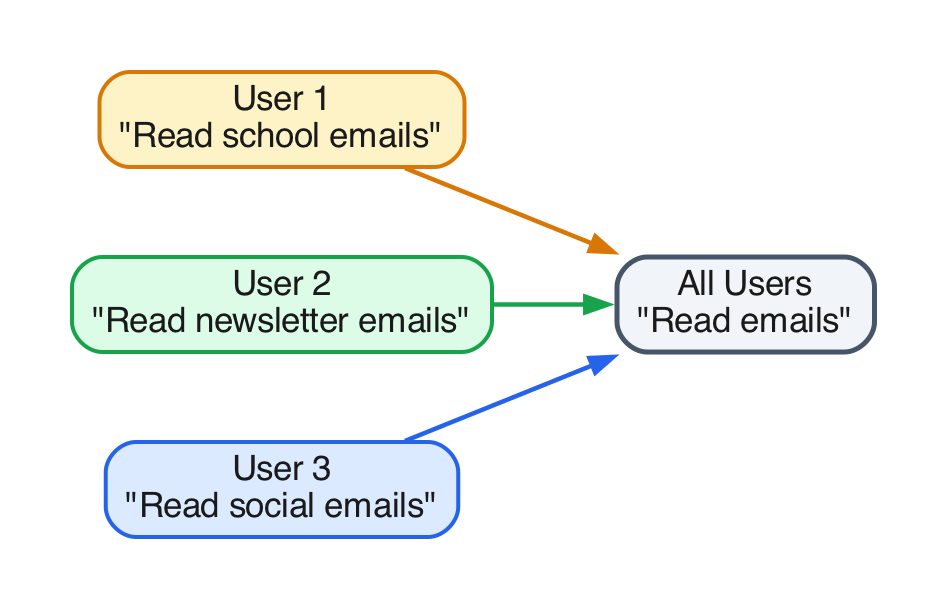
User behavior patterns in the morning
Two popular answers miss this job for opposite reasons.
Cloud personalization centralizes every device through a service. That buys scale and shared features, but it needs connectivity, costs money at user scale, and moves sensitive behavior—not just content—off the device.
On-device general LLMs keep inference local and shine at language tasks: summarize this, draft that, translate those. They are the wrong tool for “what does this person usually tap next on this screen?” You can prompt around the edges; you still do not own a compact, always-on sequence model of one user’s UI habits.
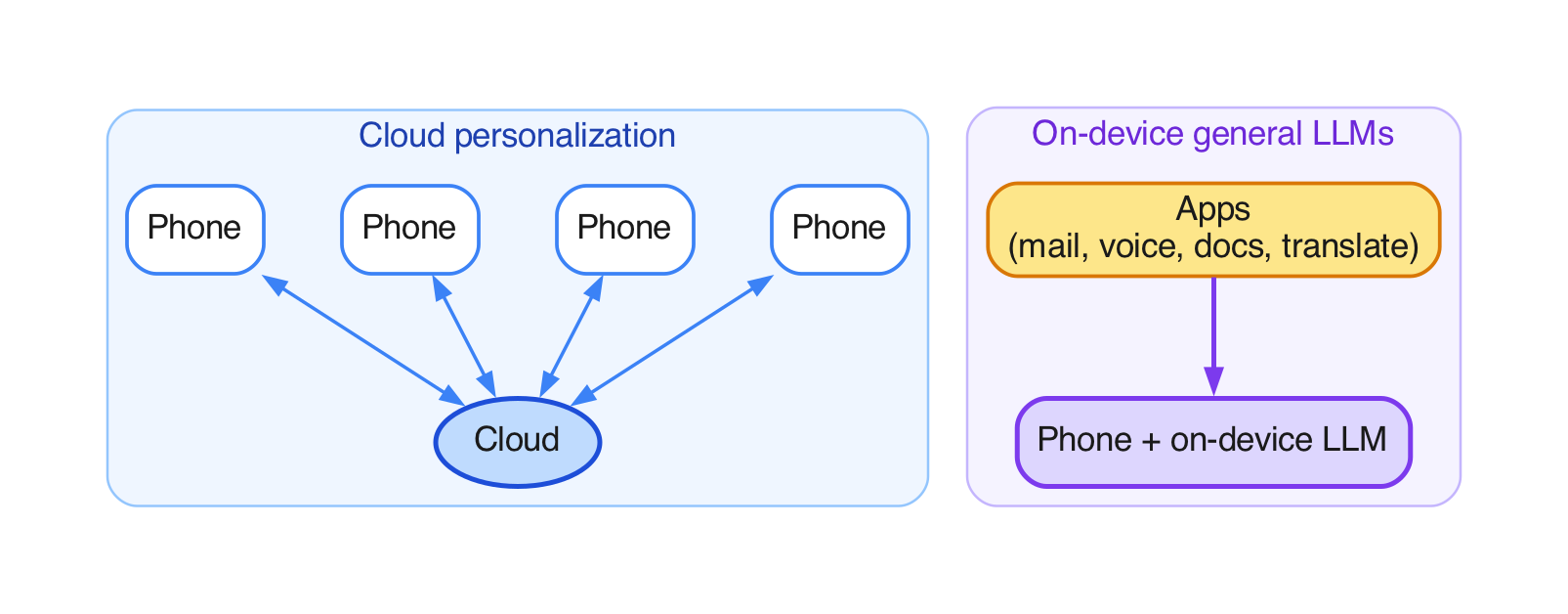
Cloud personalization (top) and on-device general LLMs (bottom)
The gap in between is the interesting one: local learning from ordered UI events, small enough to stay resident on a phone, private by architecture rather than by policy document.
The approach
The host app should not have to become an ML platform. It needs a thin way to say “the user did this” and a controlled way to say “you may do that.”
Recording. Thin wrapper UIs sit over ordinary controls (rows, columns, buttons, text, …) and emit light behavior events. Those events enter an on-device library: a label assigner turns them into training examples, an action registry holds product-defined registered actions, and local storage keeps the sequence history on device.
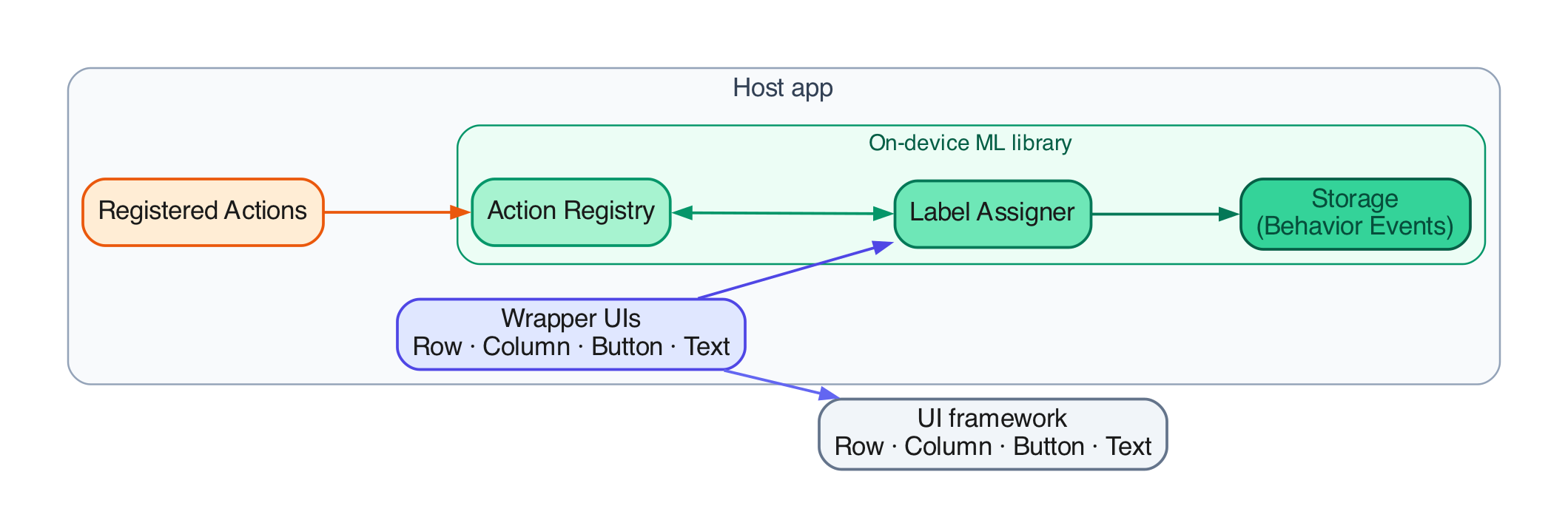
Behavior event recording through wrapper UIs
Training. User actions are recorded with simple context—time, and optionally location—plus a label, written into secure on-device storage, then used to train or update a per-user model. The loop is local end to end.

Training flow
Inference. At prediction time the model checks the same kind of context, scores a next behavior from the recent sequence, and—only if policy allows—drives an action on the device.
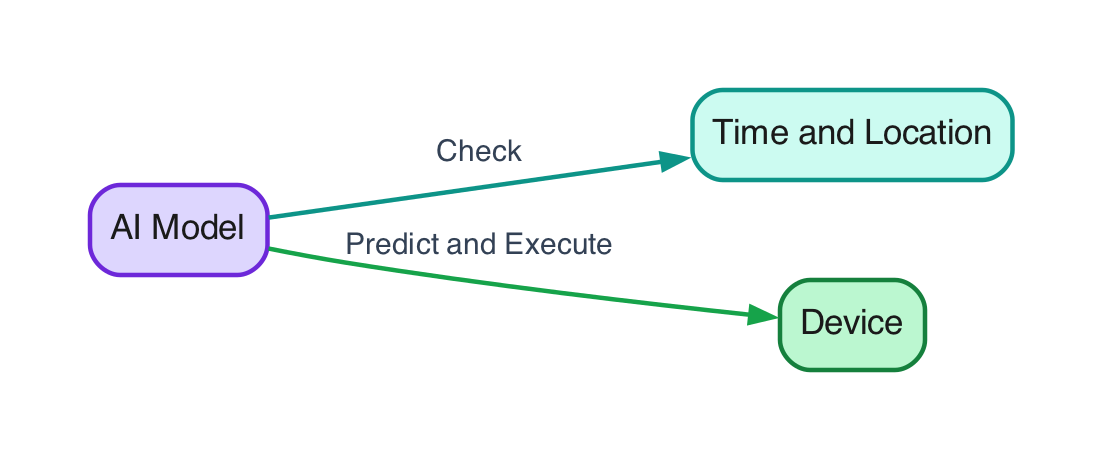
Inference flow
The important product move is the gate between prediction and execution. Easy-to-undo suggestions can fire at lower confidence. Hard-to-undo actions—delete, send, pay—need much higher confidence, or no automation at all. The model proposes; registered actions and thresholds decide. That separation is what makes hyper-personalization feel helpful instead of reckless.
Cold start and drift are first-class, not afterthoughts: until enough local sequence exists, the host can fall back to heuristics; as habits change, the on-device model is meant to retrain or fine-tune on a cadence rather than freeze a first week forever.
Sequence model, not language model
This is a behavior / sequence model. It maps a short window of UI events to a next label (or a ranking over items). It does not read message bodies, write replies, or answer questions in prose. Those are LLM jobs.
A compact shared encoder turns recent events into a user vector; small task heads specialize—next action, content affinity, and similar. Exact sizes depend on schema and device. The public claim is the order of magnitude: always-on phone inference for one person’s habits, not a multi-gigabyte general model doing language in the background and hoping habit falls out.
That specialization is the point. Cloud analytics still matter for fleet-wide questions. On-device LLMs still matter for language. Hyper-personalization of in-app behavior is often a sequence problem with a privacy constraint—and that is a different machine.
Takeaway
If you only remember one thing: personalization of UX habits is not the same problem as personalization of content or language. A tiny on-device sequence model, fed by thin UI wrappers and fenced by confidence-gated actions, is a coherent way to chase the former while keeping behavior data local.
It complements cloud personalization and on-device LLMs; it does not replace them. Formal claims live in the patent filing.